
BLOG / Employee Benefits
Salesforce 2027 Open Enrollment: What Employees Need to Know

Open Enrollment is your annual opportunity to review your Salesforce employee benefits, compare your options, and make changes for the year ahead. With healthcare costs continuing to rise and several updates taking effect in 2027, it’s worth taking some time to make sure your benefits still meet your needs and fit your financial goals.
Salesforce’s 2027 Open Enrollment runs from November 2 through November 15, 2026. You must submit your elections in Workday by 11:59 p.m. Pacific Time on November 15. Your new benefits will take effect on January 1, 2027.
If you don’t make changes, most of your 2026 benefits will automatically carry over to 2027. However, you must re-enroll in your Health Savings Account (HSA) and Flexible Spending Accounts (FSAs) each year if you want to continue contributing.
Here’s a breakdown of what’s changing, what stays the same, and what to consider before making your 2027 benefits elections.
#1: Review Your 2027 Medical Plan Options and Costs
Salesforce will continue offering medical coverage through Aetna, UnitedHealthcare (UHC), and Kaiser Permanente in select locations. The company is maintaining its existing plan options with only minor changes to plan design.
While Salesforce continues to cover most of the rising cost of healthcare, employees will see modest increases in monthly contributions for most plans in 2027.
2027 Monthly Medical Plan Contributions
The following amounts represent your monthly employee contribution for medical coverage.
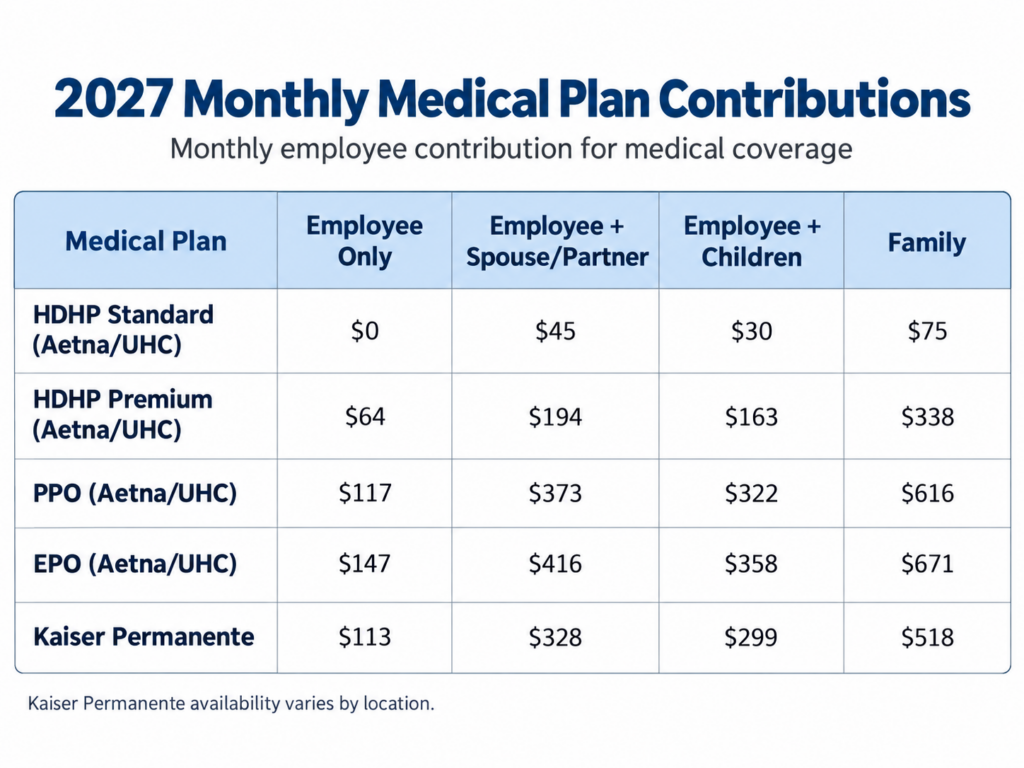
Monthly contributions shown are for 2027. Source: Salesforce.
The most notable change affects the HDHP Standard plan. Employee-only coverage remains free, but employees who cover a spouse, domestic partner, or children will pay a monthly contribution for the first time. These new contributions range from $30 to $75 per month.
For the other plans, monthly increases are relatively small:
- HDHP Premium: Increases of $3 to $15 per month.
- PPO: Increases of $5 to $28 per month.
- EPO: Increases of $7 to $30 per month.
- Kaiser Permanente: Increases of $1 to $6 per month.
Kaiser Permanente plans are available in California, the Northwest, Washington, and Georgia. Employees in Hawaii have one medical plan option, the HMSA PPO Plan.
How to Compare Your Medical Plans
Monthly contributions are only part of the cost of healthcare. Before choosing a plan, consider how much you expect to spend on medical care throughout the year, including deductibles, copays, coinsurance, and out-of-pocket maximums.
For example, a high-deductible health plan (HDHP) may offer lower monthly costs, but you’ll generally pay more out of pocket before the plan begins covering certain expenses. On the other hand, a PPO or EPO may cost more each month while offering a different balance of deductibles, provider access, and cost-sharing.
If you’re considering an HDHP, remember to factor in the potential tax advantages of an HSA, along with any employer contributions you may receive.
Salesforce offers ALEX, an online benefits counselor, to help you compare the PPO, EPO, and HDHP options based on your individual circumstances. It can be a useful starting point for estimating your total annual healthcare costs.
#2: Explore New Healthcare Resources and Support During Salesforce 2027 Open Enrollment
Although Salesforce is keeping the same major healthcare partners for 2027, employees will see changes in how they access certain services.
Expanded Support Through Aetna and UHC
Aetna and UHC are expanding their member services to offer more direct support with healthcare decisions. These enhancements include:
- Personal advocacy: Help understanding benefits, resolving coverage questions, and coordinating care.
- Provider networks: Access to in-person and virtual healthcare providers, including specialized care.
- Digital tools: AI-powered resources and mobile apps to help you find providers, get answers to coverage questions, and connect with live support.
- Comprehensive care: Services that support changing healthcare needs throughout different stages of life.
As these services expand, Salesforce will discontinue its Included Health benefit on December 31, 2026.
When reviewing your medical plan, take a few minutes to compare Aetna’s and UHC’s provider networks, coverage areas, specialized services, and member resources. If you have doctors or specialists you want to continue seeing, confirm that they’re in-network under the plan you’re considering.
New Perimenopause and Menopause Support Hub
Salesforce is also introducing a Perimenopause & Menopause Support Hub in 2027. This new resource brings together medical care, mental health support, coaching, and other services to help employees manage symptoms and access appropriate care.
#3: Revisit Your Health Savings Account Contributions
If you enroll in an HDHP through Aetna or UHC, you may be eligible to contribute to a Health Savings Account (HSA).
An HSA offers several tax advantages. Your contributions can reduce your taxable income, investment earnings grow tax-free, and withdrawals for qualified medical expenses are tax-free. Unlike an FSA, your full HSA balance carries forward from year to year, and the account stays with you if you change jobs or retire.
Higher HSA Contribution Limits for 2027
The IRS is increasing the annual HSA contribution limits in 2027.
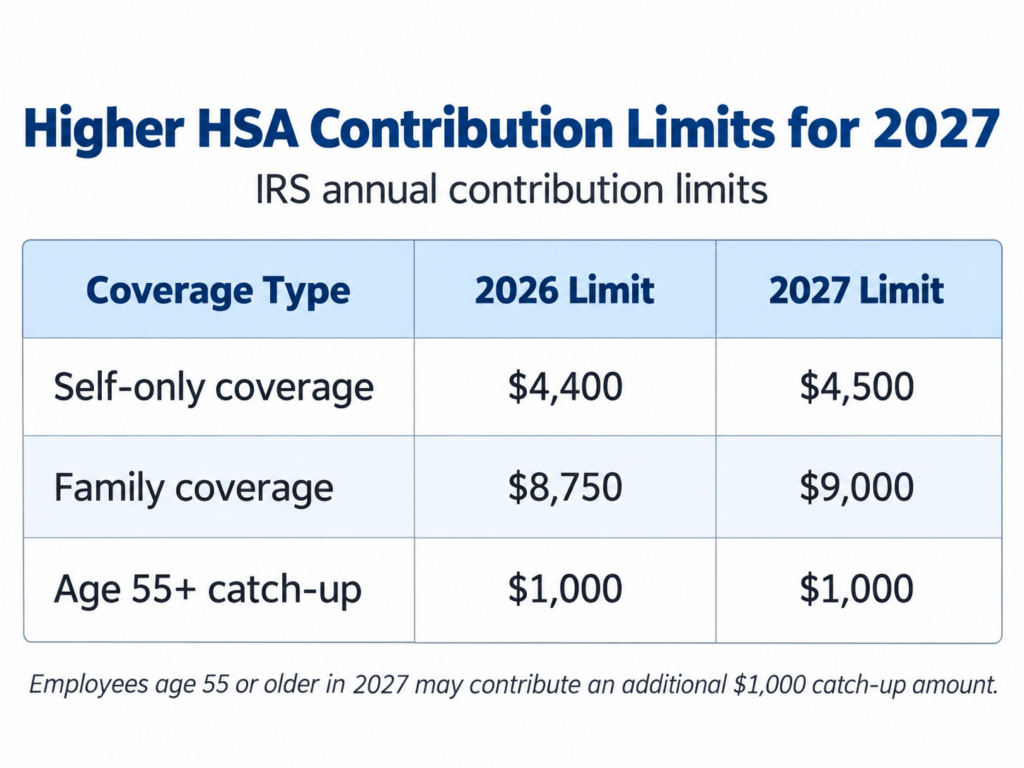
Source: Internal Revenue Service
Salesforce also contributes to your HSA if you enroll in the HDHP Premium plan:
- $1,000 for employee-only coverage or $2,000 for family coverage.
These employer contributions count toward the annual IRS limits. For example, if you have family coverage under the HDHP Premium plan and receive Salesforce’s $2,000 contribution, you can contribute another $7,000 in 2027, assuming you’re eligible for the full annual limit and don’t qualify for catch-up contributions.
Salesforce also allows you to invest HSA balances above $500, giving you the opportunity to build savings for future healthcare expenses.
What to consider: If you can comfortably cover your current medical expenses from other funds, contributing more to your HSA may be a useful long-term savings strategy. HSA assets can help pay qualified medical expenses in retirement, making the account a valuable complement to your other retirement savings.
Remember that even if you contributed to an HSA in 2026, you’ll need to make a new election during Salesforce 2027 Open Enrollment.
#4: Update Your Flexible Spending Account Elections
Salesforce offers several Flexible Spending Accounts (FSAs) that allow you to set aside pretax dollars for eligible expenses.
Like your HSA, your FSA elections do not automatically renew. You must re-enroll during Open Enrollment if you want to participate in 2027.
Healthcare FSA and Limited Purpose FSA
The annual contribution limit for both accounts increases from $3,300 in 2026 to $3,400 in 2027.
A Healthcare FSA can help you pay eligible medical expenses with pretax dollars. A Limited Purpose FSA generally covers eligible dental and vision expenses and can be particularly useful if you also contribute to an HSA.
Salesforce allows unused balances between $20 and $680 to carry over to the following plan year. Because amounts above the permitted carryover may be forfeited, it’s worth estimating your expected expenses carefully before choosing your contribution.
Dependent Care FSA
The Dependent Care FSA helps eligible employees pay qualified dependent care expenses, such as daycare, preschool, and certain adult care services, with pretax dollars.
For 2027, Salesforce’s contribution limits depend on your on-target earnings (OTE) as of October 1, 2026.
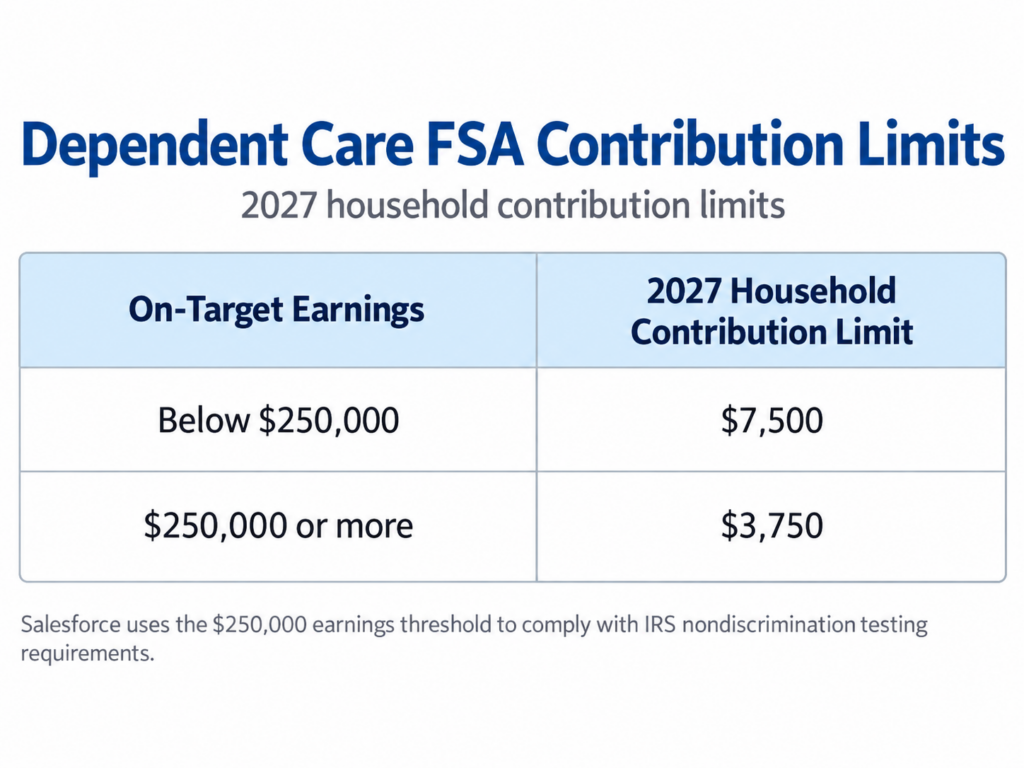
Source: Salesforce
If you have young children or other qualifying dependents, this account may offer meaningful tax savings. However, you should consider how much you reasonably expect to spend during the year, as unused dependent care funds generally can’t roll over.
Keep in mind that you generally can’t change your FSA contribution elections during the year unless you experience a qualifying life event, such as marriage or the birth of a child.
#5: Check Your Dental and Vision Benefits
Salesforce’s dental and vision benefits remain largely unchanged for 2027, with one addition to vision coverage.
Dental Coverage
Delta Dental will continue offering Standard and Premium plans, with no changes to benefits or monthly contributions.
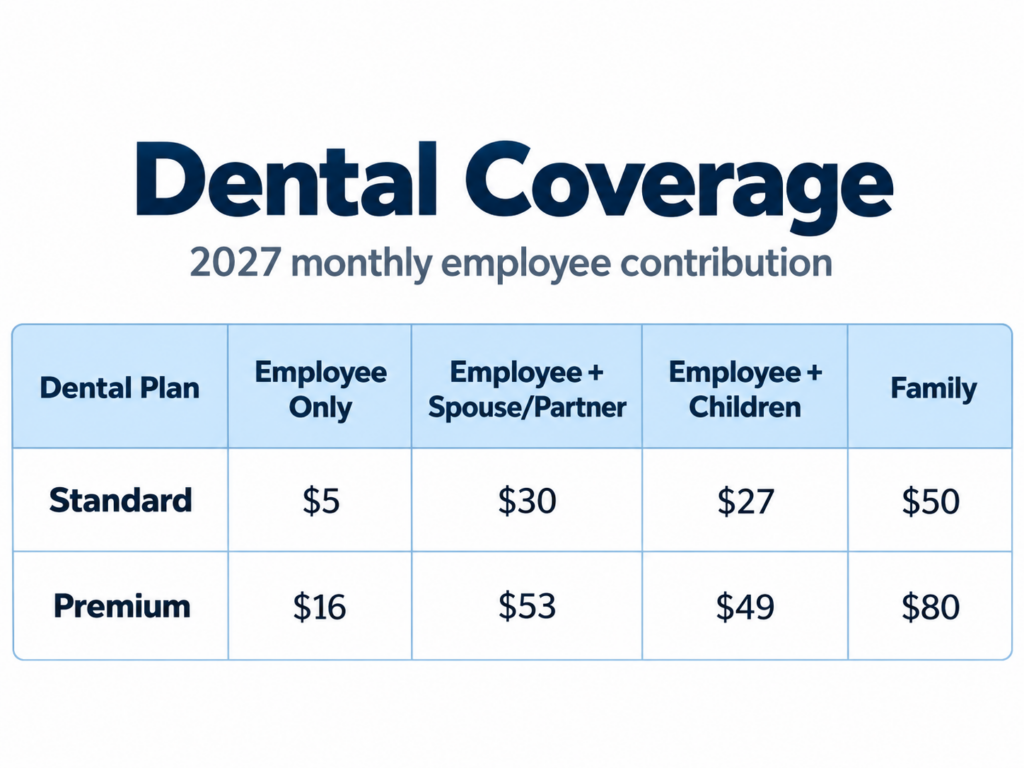
Source: Salesforce 2027 Open Enrollment
Review your expected dental needs for the coming year, especially if you or a family member anticipate major dental work or orthodontic treatment.
Vision Coverage
VSP Vision premiums will also remain unchanged in 2027. The plan adds retinal screening for a small copay.
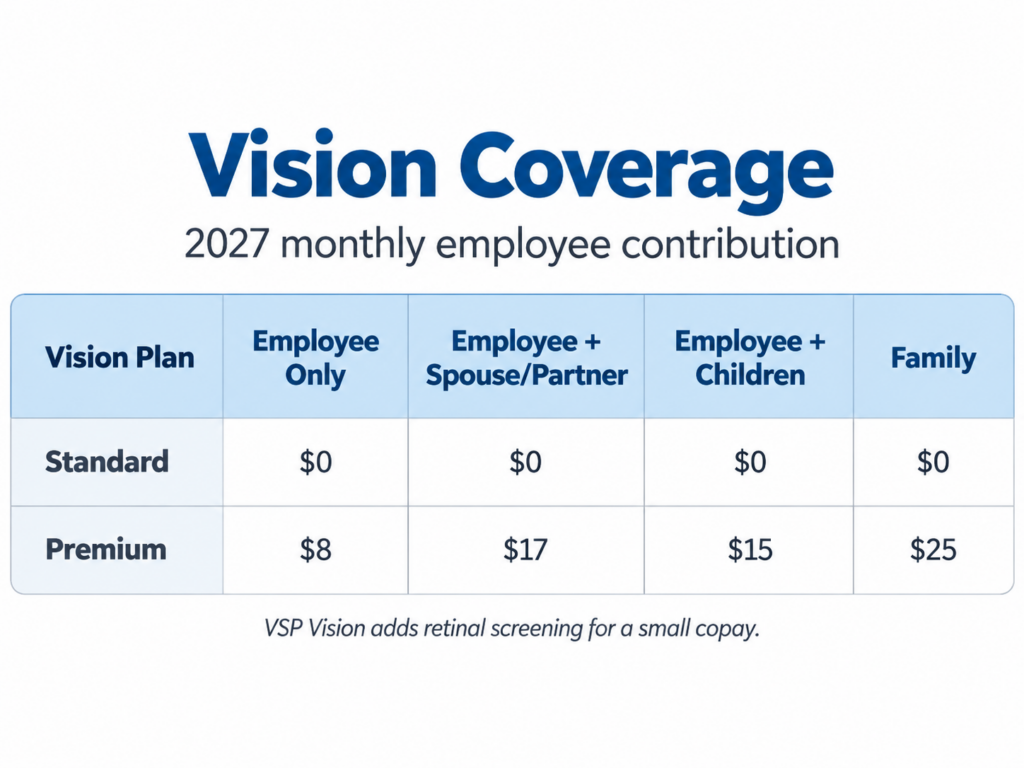
Source: Salesforce 2027 Open Enrollment
If you wear glasses or contacts, compare your anticipated expenses with the additional coverage available under the Premium plan.
#6: Review Your Life Insurance and Beneficiaries During the Salesforce 2027 Open Enrollment Period
Salesforce will continue providing Basic Life Insurance through MetLife at no cost to employees. This coverage is automatic, so you don’t need to enroll separately.
However, Open Enrollment is a good opportunity to review whether your existing life insurance coverage is sufficient, particularly if your family circumstances or financial responsibilities have changed.
If you elect Supplemental Employee Life Insurance or Spouse/Domestic Partner Life Insurance, you may need to complete MetLife’s Statement of Health form. Any additional coverage requiring approval won’t take effect until MetLife approves your application.
Revisit Your Estate Plan
Salesforce employees also have access to MetLife’s digital estate planning library, which can help with important estate planning documents and decisions.
Even if you don’t need to make major changes to your benefits, reviewing your beneficiary designations is worthwhile. This is especially important if you’ve recently married, divorced, welcomed a child, or experienced another major life change.
It’s also a good time to make sure your beneficiaries across life insurance policies, retirement accounts, and other financial assets reflect your current wishes.
#7: Complete Your Salesforce 2027 Open Enrollment Checklist
Before the November 15 deadline, work through these steps to confirm that your benefits are ready for 2027.
- Compare your medical plans. Review monthly contributions, estimated out-of-pocket expenses, provider networks, and available HSA benefits.
- Re-enroll in your HSA and FSAs. These elections don’t carry forward automatically.
- Confirm your dependents. Make sure everyone who needs coverage is properly enrolled.
- Update your personal information. Verify your mailing address and other information in Workday.
- Review your beneficiaries. Check your life insurance and other benefit-related beneficiary designations.
- Complete any required insurance forms. If you elect supplemental life insurance coverage, submit MetLife’s Statement of Health when required.
- Verify your final elections. After enrolling, review your Benefits Dashboard in Workday to confirm your selections.
You can make your elections through Workday, using Zscaler or VPN access. Outside the annual enrollment period, you generally can change your coverage only after a qualifying life event.
Bookmark SalesforceBenefits.com for access to benefits information throughout the year.
#8: Take Advantage of Salesforce’s Enrollment Resources
Salesforce provides several resources to help employees understand their coverage and make informed decisions:
- @Employee Agent on Slack. Use this resource for general enrollment questions and help finding relevant benefits information.
- ALEX benefits counselor. Compare medical plans side by side and receive personalized recommendations based on your healthcare needs.
- Aetna and UHC support teams. Contact your healthcare partner for help confirming provider networks, understanding coverage, and accessing virtual care.
- Virtual office hours. Salesforce offers 30-minute individual consultations during the open enrollment period.
Your 2027 Benefits and Broader Financial Plan
Your Salesforce benefits are an important part of your overall compensation and financial picture. Choosing the right medical coverage, taking advantage of tax-advantaged savings accounts, and reviewing your insurance protection can all support your financial goals.
At Simplicity Wealth Management, we have experience helping Salesforce employees make the most of their employee benefits, manage company equity compensation, and plan for the financial decisions that come with each stage of their careers. Book a free Simplicity Session to discuss your specific situation and explore how your Salesforce benefits fit into your broader financial plan.
Similar posts


Your Open Enrollment Checklist for Tech Employees


Planning a Sabbatical from Your Tech Job: How to Plan Financially

How to Turn Your RSUs Into an Epic Vacation: A Step-By-Step Guide
